 Skip to content
What if every celebration had its own energy, yet still felt like part of one unforgettable wedding weekend? That’s the goal of thoughtful Multi-day south asian wedding planning in New York and New Jersey: give each event room to shine while connecting the experience from the first gathering to the final dance.
It’s understandable if the details feel like a lot. Several celebrations can mean different traditions, timelines, venues, vendors, and guest needs to coordinate. There’s no single event formula that fits every couple. Shape your plans around the rituals and moments that matter to your families, with enough breathing room for guests to feel welcome between events.
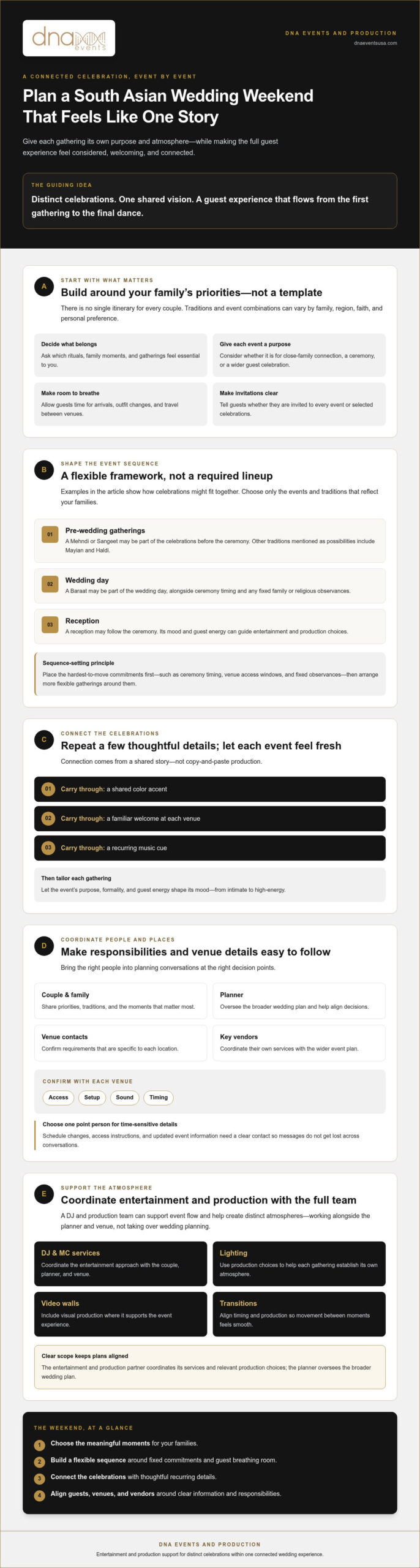
This guide offers a flexible event-by-event framework for shaping each celebration, coordinating the moving parts, and creating a cohesive guest experience. You’ll find ways to decide what belongs in each event’s plan, what guests need to know, and which vendors and production elements to coordinate. An experienced DJ and production team can support event flow and create distinct atmospheres through entertainment, lighting, video walls, and more, working alongside your planner and venue rather than taking over wedding planning.
Key Takeaways
- Use one shared vision to connect your celebrations while giving each gathering a clear purpose in the guest experience.
- Build a flexible event sequence around your family’s priorities instead of following a one-size-fits-all wedding itinerary.
- With Multi-day south asian wedding planning, consider each event’s mood, formality, and guest energy before choosing its entertainment and production.
- Keep guests informed with clear event details, and confirm access, setup, sound, and timing requirements directly with each venue.
- Coordinate DJ and MC services, lighting, video walls, and other production choices with your planner and venue to support smooth transitions and distinct atmospheres.
Why Multi-Day South Asian Wedding Planning Needs One Connected Plan
Several days of celebration can bring different generations, traditions, and circles of friends together, each with its own rhythm. But every added gathering also brings more details to align: who’s invited, where guests need to be, how they’ll travel between venues, and what each family considers essential. Multi-day south asian wedding planning works best when you shape the separate events around one shared guest experience rather than treating them as unrelated occasions.
A connected multi-day wedding plan coordinates distinct celebrations around a shared story, so each event feels meaningful on its own and welcoming as part of the whole. That story can guide the order of gatherings, guest communications, and the time people need between locations. Family priorities, cultural or religious traditions, travel plans, and venue logistics all influence the schedule. For example, decide whether guests are invited to every event or only selected celebrations, then make those expectations clear in the itinerary.
There’s no universal itinerary. Customs and event combinations vary by family, region, faith, and personal preference. An overview of traditional Punjabi wedding events, including Sangeet, Mayian, and Haldi, can help you explore possibilities, but it isn’t a required checklist. Choose the ceremonies and gatherings that reflect your families and the celebration you want to create.
What makes a multi-day wedding feel connected?
Connection comes from thoughtful repetition, not copy-and-paste production. A shared color accent, a familiar welcome at each venue, or a recurring music cue can link the celebrations while letting each one have its own mood. Ask which moments and family traditions matter most. Use the answers to decide what carries through and what should feel fresh, whether an event is intimate or high-energy.
Who should be involved in the planning conversations?
Bring in the couple, involved family members, the wedding planner, venue contacts, and key vendors at the right decision points. Choose one point person for time-sensitive details, such as schedule changes, access instructions, or updated event information. This gives everyone a clear contact and helps prevent messages from getting lost across multiple conversations.
Define each person’s role early. A planner can oversee the broader wedding plan, venue contacts can confirm location-specific requirements, and vendors can coordinate their own services. DNA Events and Production can contribute as an entertainment and production partner, coordinating DJ and MC services and relevant production choices with the couple, planner, and venue. The company doesn’t provide full-service wedding planning, so clear responsibilities help keep creative ideas and practical decisions aligned.
How to Map the Events in a Multi-Day South Asian Wedding
Build the sequence around your priorities, not a template. Multi-day south asian wedding planning starts by deciding which moments are essential to you and your families, then arranging the celebrations so guests aren’t rushed between arrivals, outfit changes, and venue transfers. A schedule that works beautifully for one family may not suit another.
Which celebrations might be part of the schedule?
Some couples include a Mehndi or Sangeet before the ceremony, a Baraat as part of the wedding day, and a reception afterward. These are examples, not a required lineup. Names, meanings, customs, and event combinations can vary by family, community, and faith. Ask relatives what a tradition means to them and how they’d like it observed, then decide together which elements feel right for your celebration.
Think about the purpose of each gathering, too. Is it a chance for close family to connect, a ceremony with particular timing, or a lively event for a wider guest group? New Jersey welcomes a range of cultural events, as reflected in New Jersey’s cultural festivals. If guests are traveling to New York, New Jersey, Long Island, or Edison, local information may also help them plan time around the wedding.
How should couples build a workable event sequence?
Start with the commitments that are hardest to move: ceremony timing, venue access windows, and fixed family or religious observances. Place more flexible gatherings around them. If guests arrive from out of town on the first day, for example, a relaxed welcome may make more sense than a major event scheduled before they’ve had time to settle in. Confirm timing and access details with each venue rather than assuming one location’s rules apply to another.
Next, map the transitions. Account for getting ready, travel between venues, room resets, and the time guests need to arrive and find their way. Share the draft schedule with your planner, venue contacts, and key vendors. Coordinate music and announcements against the actual sequence so the entertainment team knows when to cue an entrance, guide guests, or shift the energy.
A simple event-mapping method:
- 1. Choose the traditions and gatherings that matter to your families.
- 2. Lock in ceremony times and venue access details.
- 3. Arrange flexible events around those fixed points.
- 4. Add realistic travel, arrival, and setup transitions.
- 5. Share the confirmed timeline with guests and vendors.
Once the sequence is taking shape, explore DJ and production services that can support the flow of each celebration alongside your planner and venues.
How to Give Each South Asian Wedding Event Its Own Feel
A wedding weekend doesn’t need one playlist, one mood, or the same production setup at every gathering. Each event can have its own identity while still feeling connected to the celebrations around it. For Multi-day south asian wedding planning, start with what you want guests to experience at each event, then match the music and atmosphere to that purpose. Personal taste matters more than assumptions about what a particular community “usually” wants.
A Sangeet might center on family performances and group participation, while a reception may leave more room for formal introductions, dinner, and open dancing. Either event can take a different shape. Decide whether performances, family moments, or a full dance floor should lead the evening, and share those priorities with your entertainment team. For more ideas, explore South Asian wedding entertainment and Sangeet ideas.
Match the atmosphere to each event’s purpose
Use this comparison as a starting point, not a rulebook. Adjust it to your guest list, traditions, and preferences.
| Event goal | Guest energy and formality | Entertainment and production to consider |
|---|---|---|
| Family gathering | Relaxed, conversational, close-knit | Background music, comfortable lounge décor, and gentle lighting |
| Sangeet | Participatory, celebratory, performance-friendly | Planned music cues, clear announcements, and space for performances and dancing |
| Ceremony | Focused, meaningful, shaped by the couple’s traditions | Music and sound cues coordinated with the ceremony schedule and venue |
| Reception | Often more formal at first, then ready for open dancing | MC announcements, a dance-floor setup, and lighting that can shift with the evening |
Let music and production reflect your preferences
Bollywood, Bhangra, contemporary tracks, and other styles can all be part of the mix if they suit the couple and their guests. Tell the DJ which sounds you want at each event, and flag must-play and do-not-play songs. Share name pronunciations and any family sensitivities before the schedule is finalized. Those details help the MC make introductions thoughtfully and keep the music personal rather than generic.
Production choices can shape the mood without making every venue feel identical. Lighting might create a softer welcome at one event and a more energized dance setting at another. Visuals or a video wall may suit a particular celebration if they support its purpose and fit the venue requirements. Coordinate these choices with your planner and venue. DNA Events and Production provides DJ and MC services and event production, giving couples options to discuss with their planning team as each event’s atmosphere takes shape.
How to Coordinate Guests, Venues, and Timelines Across NY and NJ
Several celebrations can mean different addresses, arrival plans, and setup needs. A clear shared schedule helps guests feel looked after and gives your planner, venues, and vendors a common reference point. For Multi-day south asian wedding planning across New York, New Jersey, Long Island, or Edison, research and confirm travel time rather than guessing. Check route estimates for the event date and time, then build in a buffer that reflects your plans.
What should guests know before a multi-day celebration?
Give guests one easy-to-follow itinerary through the communication channel your couple or families prefer. Include the essentials for each event:
- When and where: event start time, venue address, and any arrival guidance.
- What to wear: dress guidance for each gathering, if relevant.
- How to get there: transportation and parking information, with details checked before sharing.
- Who to contact: a designated point person for questions or schedule updates.
If plans change, send the update through the same channel guests already use. For multiple venues, explain the transition: tell guests whether they’re expected to travel independently or follow another arrangement, and confirm the details before communicating them.
What should couples confirm with each venue and vendor?
Venue requirements can differ, even for events in the same region. Ask each venue directly about access windows, load-in, setup rules, sound requirements, room transitions, and restrictions that could affect your plans. Check transport estimates and traffic conditions for your actual event dates rather than relying on assumptions. Add the confirmed details to a shared working timeline.
- Align the planner and venue contacts on access, room readiness, and transitions.
- Share event timings and key handoffs with the DJ, MC, and production team.
- Confirm when equipment setup and breakdown can happen, and who needs venue access.
- Pass along approved schedule changes to vendors and the guest point person.
Entertainment coordination is part of the wider timeline. Share the event sequence, announcement cues, and relevant venue requirements with the DJ and MC team. Indian wedding DJ production guidance can help you prepare for those conversations. If lounge seating is part of the guest experience, also review wedding lounge furniture rental in Edison and confirm setup needs with the venue.
For help coordinating entertainment and production details with your planner and venue, explore DJ and production services.
How Entertainment and Production Support a Multi-Day South Asian Wedding
Entertainment and production help turn a timeline into a lived experience. A DJ and MC can support transitions between planned moments, make announcements, and respond to the room’s energy, while production choices help shape each event’s atmosphere. In multi-day south asian wedding planning, the goal isn’t to add every available feature. It’s to choose elements that suit the event, the venue, and your priorities.
Keep responsibilities clear. Your planner coordinates the broader wedding plan, the venue confirms its requirements, and the entertainment and production team coordinates its services with those plans. DNA Events and Production offers DJ and MC services and production options for South Asian celebrations, but it isn’t a full-service wedding planner.
Which production elements belong in the event plan?
Start with the purpose of each gathering, then consider which options support it. A lively, dance-focused celebration may call for a dance floor and lighting, while a family gathering may benefit more from lounge décor or a photo booth. A video wall, visuals, or special effects may fit a particular event if they support the couple’s vision and suit the venue. No element is essential by default.
- Lighting: Consider how it can help establish the mood for a ceremony, reception, or dance-focused event.
- Video walls and visuals: Explore these when visual content has a clear role in the celebration.
- Dance floors and special effects: Consider them for events where dancing and heightened energy are priorities.
- Lounge décor and photo booths: Choose them when comfortable gathering spaces or an interactive guest activity fit the plan.
Before selecting production, ask the venue to confirm access, setup requirements, sound conditions, and any permissions that apply. A feature that looks exciting on paper still needs to work within the room and the event schedule.
How can couples brief an entertainment and production team?
Share the master timeline and the purpose of each event, along with key family names, cultural preferences, music requests, and pronunciation guidance. Note must-play and do-not-play songs, planned performances, announcement details, and transitions that need a cue. Flag any family sensitivities early so the team can prepare with care and coordinate timing with the planner and venue.
Clear notes create a stronger handoff and leave more room to enjoy the celebration as it unfolds. To discuss entertainment and production support for your wedding events, explore DNA Events and Production’s DJ and production services.
Shape a Wedding Weekend That Feels Like Yours
The most memorable wedding weekends balance thoughtful coordination with room for each celebration to feel distinct. Build your schedule around the traditions and moments that matter to your families, then connect the events with clear guest information, realistic transitions, and shared creative details. That’s the heart of Multi-day south asian wedding planning: a connected experience shaped by your priorities, not a one-size-fits-all itinerary.
Entertainment and production can help carry that vision across each gathering. DNA Events and Production brings over two decades of South Asian event entertainment experience, with DJ and MC services for Indian, Pakistani, and Bangladeshi weddings in New York, New Jersey, Long Island, and Edison. Production options include lighting, video walls, dance floors, and photo booths, coordinated with your planner and venue.
Choose entertainment and production that fits the atmosphere you want at each event. Contact DNA Events and Production to discuss DJ, MC, and event production services for your celebration.
Frequently Asked Questions
How do you plan a multi-day South Asian wedding?
Plan each event around your family’s priorities, then connect the schedule through clear communication and thoughtful transitions. List the traditions and gatherings you want, lock in fixed ceremony and venue times, and fit flexible events around them. Allow time for travel, getting ready, and room changes. Multi-day south asian wedding planning also means sharing the confirmed timeline with guests, your planner, venues, and vendors so everyone understands their role.
How many days does a South Asian wedding usually last?
There’s no set number of days. The celebration’s length depends on the couple, family traditions, faith, and chosen events. Some couples may gather for several occasions across multiple days, while others may prefer a more compact schedule. Decide which moments matter most, consider guest travel and energy, and build a timeline that gives each gathering enough space without making guests feel rushed.
What events can be included in a multi-day South Asian wedding?
Possible events include a Mehndi, Sangeet, Baraat, ceremony, and reception, along with other family or cultural gatherings. These are options, not a standard checklist. Names, meanings, and formats vary across families, communities, and faiths. Ask relatives which traditions they value and how they understand them, then choose the celebrations that fit your plans. Share event details with guests so they know which gatherings they’re invited to attend.
How do you keep each wedding event distinct while connecting the celebration?
Give each event a clear purpose, then use a few shared details to make the overall celebration feel connected. A recurring music cue, welcoming touch, or design element can link the days without making every gathering look or sound the same. Set the mood according to your preferences: one event might focus on family performances, while another leaves more time for open dancing. Avoid assumptions about what a community’s celebration should include.
How far apart should multi-day wedding venues be in New York or New Jersey?
There’s no ideal mileage that works for every wedding. Choose venues with guest travel and event timing in mind, and check route estimates for the actual day and time rather than relying on distance alone. A trip between New York, New Jersey, Long Island, or Edison can be affected by traffic and transport plans. Confirm travel arrangements, allow a practical buffer, and make directions and parking information easy for guests to find.
Do you need a wedding planner for a multi-day South Asian wedding?
A planner isn’t a universal requirement, but coordinating several events, venues, and vendor timelines can make planning support useful. Consider your schedule, the number of decisions to manage, and who can serve as the main point of contact. Clarify responsibilities before booking: a planner handles the broader wedding plan, while vendors coordinate their own services. DNA Events and Production provides entertainment and production, not full-service wedding planning.
What should couples share with their wedding DJ before a multi-day celebration?
Share the master timeline, the goal and mood for each event, and the moments that need music or an announcement cue. Include key family names with pronunciation guidance, music requests, must-play and do-not-play notes, and any cultural preferences or sensitivities. Tell the DJ about planned performances and transitions, too. For events at different venues, provide confirmed schedules and relevant venue requirements so entertainment can be coordinated with the planner and venue contacts.
